Radiology interpretation is among the most cognitively demanding activities in clinical medicine. It requires sustained attention, advanced visual processing, memory integration, and complex decision making, often under significant time pressure. Understanding the strain, many organizations are now considering the physical comfort of their reading room. However, far fewer have fully examined how the their environment itself shapes cognitive load and by extension, diagnostic performance, safety, and sustained reading.
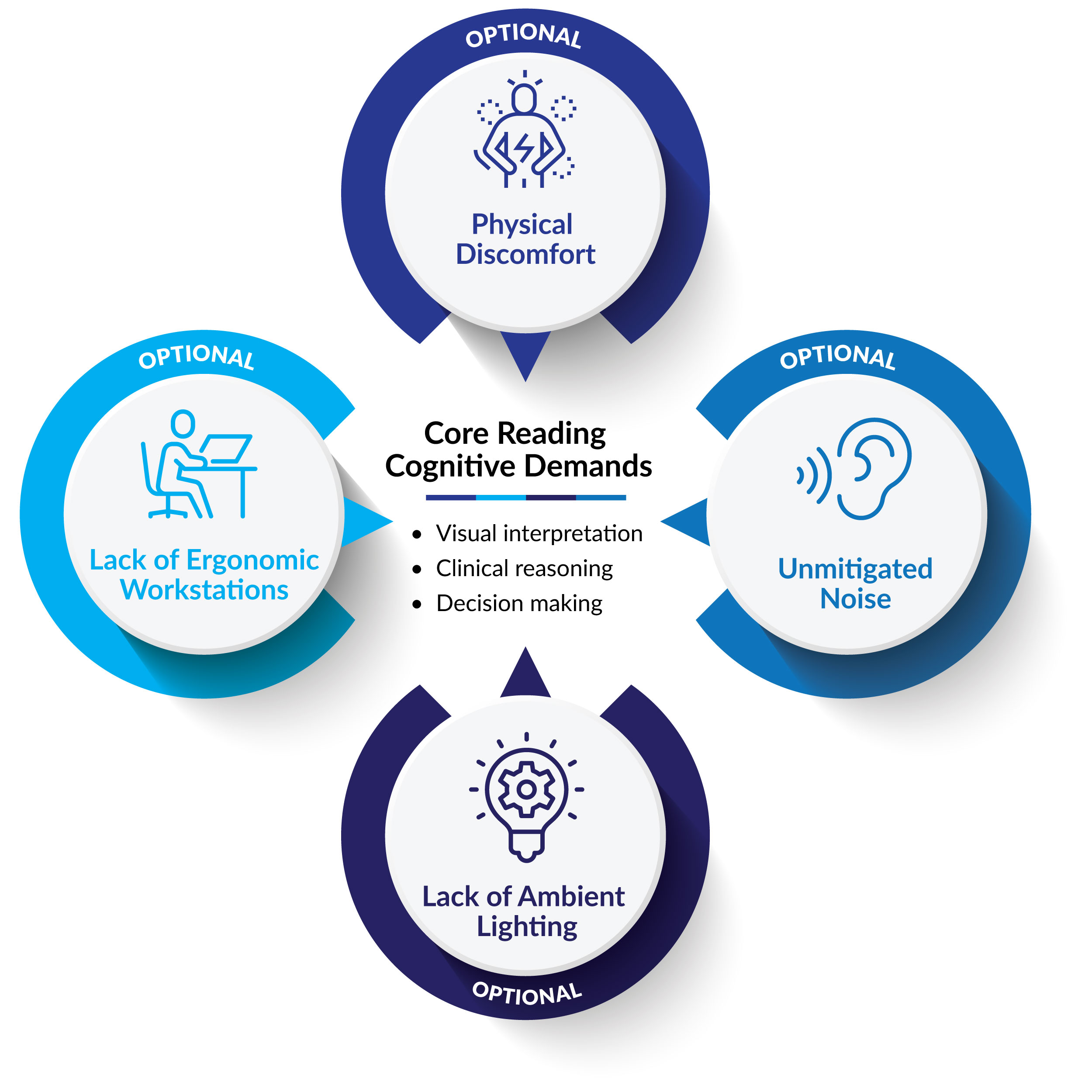
In the radiology reading room, cognitive load is inherent not optional. What is optional is the additional, unnecessary load imposed by environments that force radiologists to compensate for visual strain, noise, physical discomfort, or poor spatial organization. Reading room design plays a direct and measurable role in either amplifying or reducing this burden.
Cognitive Load in the Radiology Reading Room
Cognitive load increases when the brain must allocate resources to filter distractions, correct visual inconsistencies, or manage physical discomfort instead of focusing on image interpretation. This often means interpreting complex imaging studies while adapting to glare, uneven lighting, ambient noise, awkward display placement, physical discomfort and/or constrained postures.
Sustained elevations in cognitive load are associated with mental fatigue, slower interpretation times, and higher error risk. Diagnostic error rates in radiology have been estimated to range from approximately 3 to 5 percent across modalities, with fatigue and environmental distraction identified as contributing factors rather than isolated causes (1). Over time, excessive cognitive load also contributes to burnout by transforming focused clinical work into a continuous state of mental compensation.
Estimated diagnostic error rate
due to sustained elevations in cognitive load
Lighting That Supports Mental Endurance
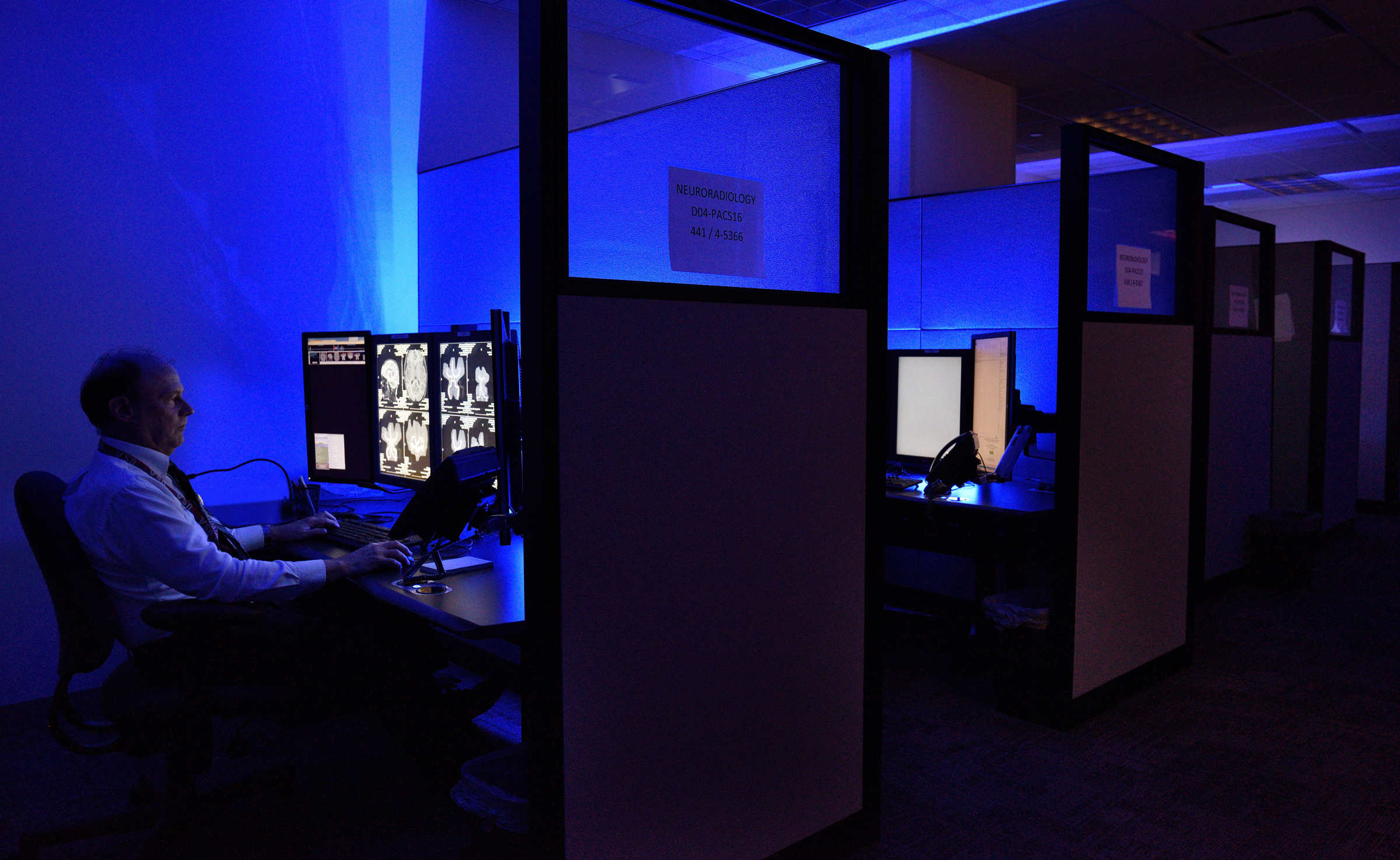
Lighting is one of the most influential and frequently underestimated components of cognitive ergonomics. High contrast between diagnostic monitors and surrounding surfaces, uncontrolled glare, or inconsistent illumination requires constant visual adaptation. Each adaptation consumes cognitive resources that should be reserved for interpretation.
Research has shown that suboptimal lighting conditions increase visual fatigue and reduce reading efficiency during prolonged diagnostic tasks (2). Ergonomically designed reading environments employ evenly distributed ambient lighting, minimize reflective surfaces, and allow precise control of luminance levels. Reading rooms that align lighting with circadian principles support alertness during daytime reading and reduce strain during extended or overnight shifts, when visual fatigue compounds cognitive fatigue.
Sound Control and the Cost of Distraction
Noise is not merely a comfort issue. It is a cognitive one. Each auditory interruption requires mental processing, even when it does not fully capture conscious attention. Studies across healthcare settings have demonstrated that task interruptions increase cognitive load and are associated with higher error rates in complex cognitive work (3).
In radiology, where concentration and pattern recognition are paramount, acoustic design becomes a performance safeguard. Sound absorbing materials, thoughtful spatial zoning, and separation of collaborative and focused reading areas help preserve cognitive bandwidth. When unnecessary auditory input is reduced, radiologists are better able to sustain deep focus over extended reading sessions.
Visual Organization and Display Layout
The organization of the visual field directly affects how efficiently information is processed. Poorly aligned displays, fixed viewing distances, or unnatural head and eye movements introduce continuous physical discomfort. Individually, these disruptions may seem insignificant. Cumulatively, they increase cognitive effort and physical strain across the work day.
Ergonomically designed workstations with fully adjustable monitor positioning support natural eye movement, appropriate viewing distances, and individualized alignment. Research has shown that optimized workstation ergonomics can improve task efficiency and reduce perceived workload in visually intensive professions (4). When the visual environment adapts to the radiologist, rather than the reverse, cognitive resources remain focused on interpretation rather than spatial correction.
The Relationship Between Physical Comfort and Mental Clarity
Physical discomfort and cognitive load are tightly linked. Musculoskeletal strain competes for attention, even when it is low level or intermittent. Radiologists report high rates of work-related musculoskeletal symptoms, with prevalence estimates exceeding 60 percent in some studies (5). Pain and tension increase mental fatigue and degrade concentration over time.
A well-designed ergonomic workstation supports posture, encourages movement, and allows both macro and micro adjustments allowing for a reduction in physical strain and cognitive distraction simultaneously. When the body is supported, mental clarity is sustained longer. An ergonomically designed workstation, in this context, is not a comfort feature. It is a foundational component of cognitive performance, patient safety, and professional longevity.
Designing for Sustained Focus
Reducing cognitive load does not mean simplifying the work of the radiologist. The work will always demand expertise, judgment, and complex reasoning. The objective is to eliminate unnecessary mental friction introduced by the environment itself.
An ergonomically designed reading room becomes a quiet partner in performance. It supports concentration without drawing attention to itself. By addressing lighting, acoustics, visual ergonomics, and physical support as an integrated system, organizations create environments that protect mental energy, support diagnostic accuracy, and promote long term clinician well-being.
Cognitive load is invisible, but its effects are measurable. Reading room design and workstation ergonomics determines whether the environment quietly drains attention or actively supports radiologists in performing at their highest level, consistently and sustainably.
1 Brady AP. Error and discrepancy in radiology. Canadian Association of Radiologists Journal. 2017.
2 Leccese, F., et al. (2017). Lighting assessment of ergonomic workstation for radiology diagnostic reporting. Building and Environment. Siegel, E. (reported in RSNA presentation, summarized in Diagnostic Imaging, 2013).
Improve radiologist efficiency with better lighting.
3 Westbrook, J. I., et al. (2018). Task errors by emergency physicians are associated with interruptions, multitasking, and fatigue. BMJ Quality & Safety, 27(8), 655–663.
4 Richter, H. O., Sundin, S., & Long, J. (2019). Visually deficient working conditions and reduced work performance in office workers: Is it mediated by visual discomfort? International Journal of Industrial Ergonomics, 72, 128–136. https://doi.org/10.1016/j.ergon.2019.05.007
5 Al Shammari, M., et al. (2019). Musculoskeletal symptoms among radiologists in Saudi Arabia: Prevalence and associated factors. BMC Musculoskeletal Disorders, 20, 541. https://doi.org/10.1186/s12891-019-2933-1