A Better Reading Room: 3 features that transform a reading room into a ‘transparent’ environment
Radiology has entered an era defined not merely by technological advancement, but by intensification of data, expectations, and cognitive demand. The convergence of high-resolution imaging, advanced visualization platforms, and increasing study volumes has fundamentally altered the nature of diagnostic work. Radiologists are now required to sustain prolonged visual precision while simultaneously navigating complex interpretive decisions at scale.
As a result, performance can no longer be viewed as a simple function of expertise or imaging capability alone. It is directly shaped by the conditions in which that expertise is applied. The reading room, therefore, must be understood not as a backdrop to diagnostic activity, but as an essential contributor to it.
Among the many variables that influence performance, three operate with disproportionate impact:
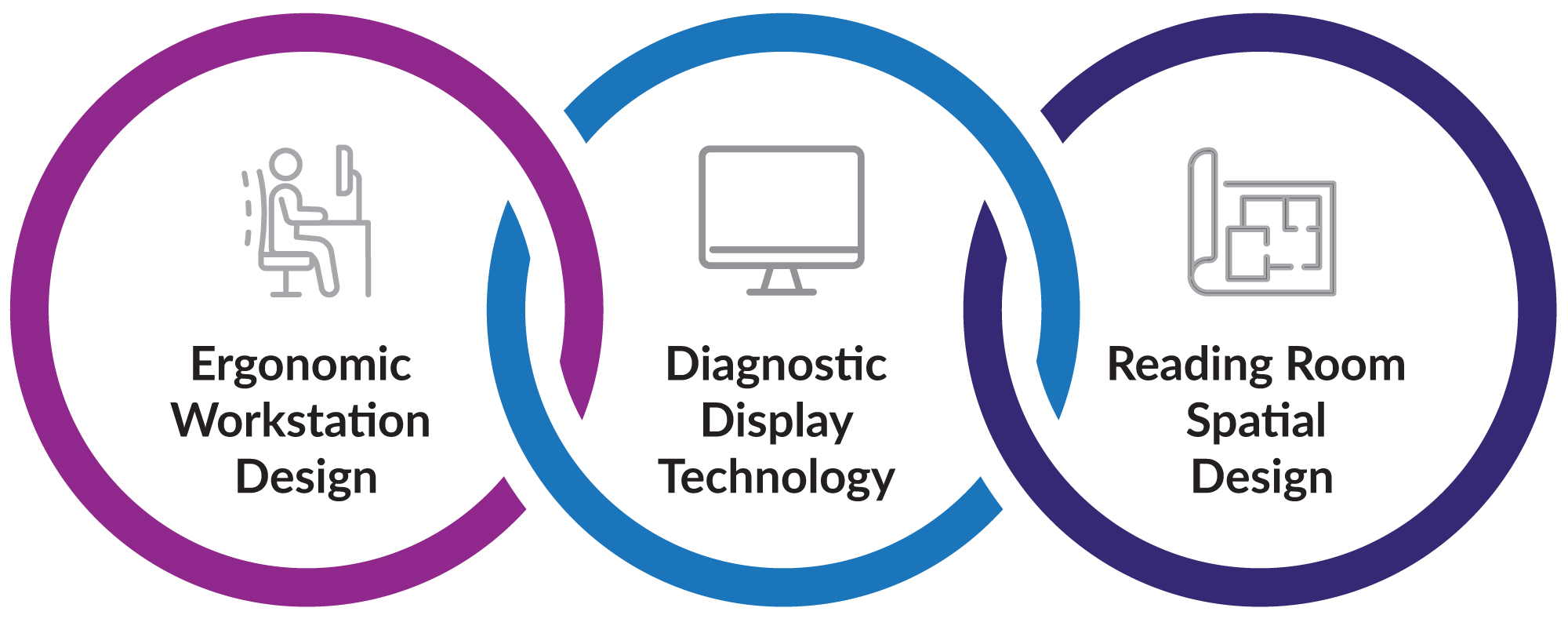
Together, these elements form an integrated performance system that, when properly aligned, recedes into the background allowing the reading room to function with an operational transparency that keeps attention fully on the work, not the environment.
In this state, the system amplifies human capability without interference. When that alignment is absent, the environment becomes perceptible in the worst way by introducing friction, increasing cognitive load, and quietly constraining overall performance.
1) Ergonomic Workstation Design: Engineering the Point of Performance
Every diagnostic decision originates at the workstation, where visual input, physical posture, and cognitive processing converge.
Alignment and its effect on cognitive efficiency
The human body is not designed to remain still for extended periods, yet modern radiology requires prolonged focus in fixed positions while maintaining a high level of visual precision. In the absence of precise ergonomic alignment, even marginal deviations in posture such as slight cervical flexion, unsupported forearms, and improper monitor height, introduce cumulative physical strain and added cognitive burden.
Well-designed ergonomically engineered workstations eliminate this friction through:The ability to precisely position monitors in alignment with natural eye level and optimal focal distance
Work surface geometry that preserves neutral joint positioning
Integrated mounting systems that preserve consistent monitor positioning and alignment throughout repeated use cycles
The benefit is not simply comfort. It is the preservation of attentional bandwidth, allowing cognitive resources to remain directed toward interpretation rather than compensation.
Dynamic movement as a sustained performance strategy
Prolonged static positioning gradually diminishes performance. Reduced circulation, accumulating musculoskeletal fatigue, and added cognitive strain are natural consequences of sustained immobility during extended interpretation sessions, ultimately diminishing diagnostic acuity over time. However, high-performance ergonomic workstations introduce structured variability.
Here is what to look for:
Seamless sit-to-stand transitions, enabling radiologists to maintain circulation and physical engagement, which helps sustain focus and reduce fatigue during long reading sessions
Low-effort adjustment of monitor position across multiple axes, allowing precise visual alignment that minimizes eye strain and supports faster, more accurate image interpretation
Rapid personalization without loss of alignment integrity, ensuring each user can immediately achieve an optimal position, reducing setup time and preserving workflow between cases
Positioning systems that bring the visual field into optimal alignment with the user, minimizing the need to lean, reach, or adjust posture, reducing physical strain and preserving sustained visual concentration
Movement, in this context, becomes a performance enhancement mechanism. It sustains physiological engagement, delays fatigue onset, and supports consistent diagnostic accuracy, enabling radiologists to maintain a high level of interpretive precision throughout extended shifts.
Standardization as a force multiplier
Inconsistency across ergonomic workstations introduces avoidable cognitive friction, particularly when transitioning from one station to another that is designed differently. Each variation in the ways in which adjustments are made, whether to monitor height, desk geometry, and even control placement forces the radiologist to pause, reorient, and relearn setup mechanisms before resuming work. These subtle but repeated changes disrupt diagnostic rhythm. While each adjustment may seem minor, their cumulative effect over the course of a shift fragments attention and diminishes overall efficiency and focus.
In a high-performance reading environment, every workstation should be engineered to function identically so that so that spatial relationships, adjustment controls, and ergonomic alignment mechanisms remain consistent and immediately intuitive.
Standardized ergonomic environments achieve this through:
The use of integrated monitor mounting systems that allow for the precise, repeatable positioning of monitor array height and depth, so that work surface geometry can be achieved with each workstation throughout the room
Predictable adjustment mechanisms, so every movement, whether raising a monitor or transitioning from sitting to standing, feels the same at every station
Immediate usability without recalibration, allowing radiologists to begin interpreting studies without pausing to adapt to entirely new setup procedures
The benefit extends beyond convenience to continuity, enabling seamless movement between workstations for collaboration, shift changes, or subspecialty workflows without disrupting cognitive rhythm. Over time, this consistency preserves momentum, reduces cumulative fatigue, and supports a more stable, efficient, and focused diagnostic process, allowing the environment to become transparent rather than a competing variable for attention.
In effect, the environment becomes transparent by removing itself as a variable so that full attention can remain on diagnostic work.
2) Diagnostic Displays: Precision Visualization as a Clinical Advantage
The diagnostic display is the final and most critical link in the imaging chain. It governs how accurately pixel data is translated into clinically actionable information and along with expertise it is a primary determinant of diagnostic accuracy, reading efficiency, and interpretive confidence. Regardless of imaging modality or acquisition quality, interpretation is ultimately constrained by the performance of the display system presenting that data.
Resolution, luminance, and perceptual performance
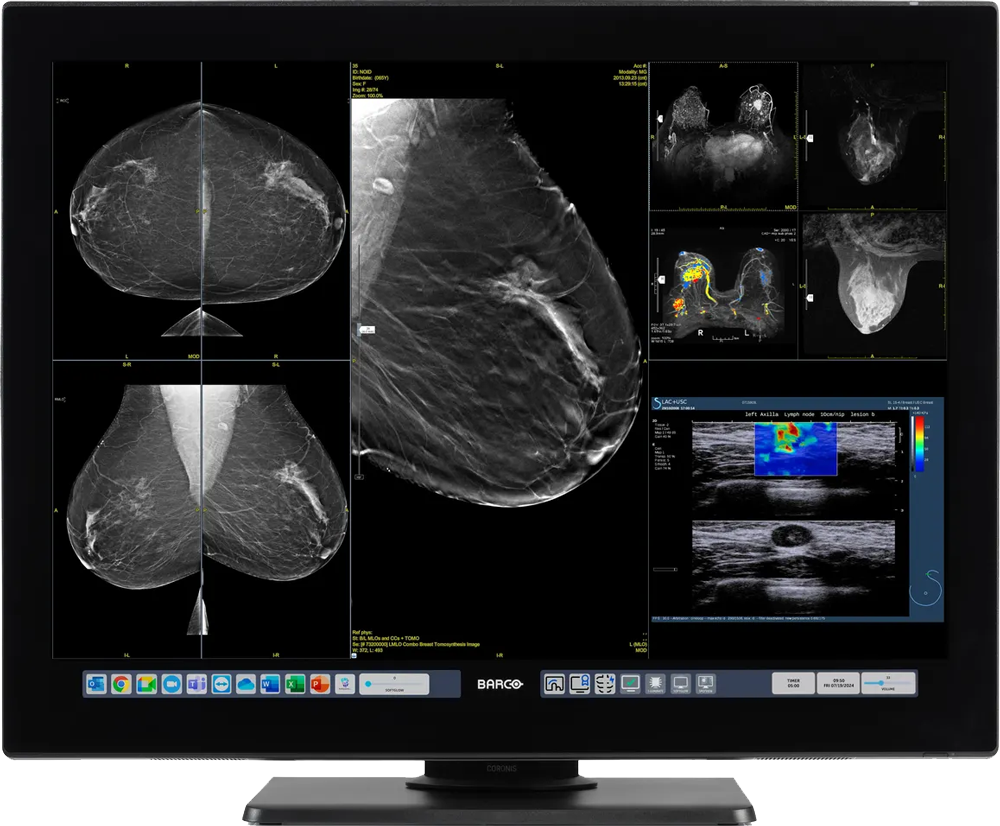
Medical-grade diagnostic displays are engineered to meet stringent radiological standards that extend well beyond the capabilities of commercial monitors. Systems from Barco are designed to achieve perceptual linearity through precise DICOM calibration, ensuring grayscale transitions align with how the human visual system detects contrast. They also incorporate luminance stabilization technologies that maintain consistent brightness over time, along with high spatial resolution that enables the reliable detection of subtle anatomical and pathological detail.
Key performance parameters can be found by examining the
Barco Coronis OneLook. Here are a few to consider:
High megapixel resolution (ideally 32M), enabling full-resolution visualization of large datasets and multi-modality imaging without excessive panning or zooming
High calibrated luminance (ideally 1,200 cd/m² and 1300:1 contrast ratio ), supporting visibility of low-contrast lesions and subtle grayscale variations
High contrast ratios and grayscale depth, ensuring that fine differences in tissue density are perceptually distinguishable
Luminance uniformity correction, maintaining consistent brightness and contrast across the entire display surface to eliminate regional bias
These characteristics directly influence the radiologist’s ability to detect low-contrast abnormalities, maintain visual consistency across large studies, and reduce interpretive uncertainty.
DICOM calibration and long-term stability
A defining feature of diagnostic displays is adherence to the DICOM Grayscale Standard Display Function (GSDF), which ensures that grayscale rendering aligns with human visual perception. This creates a predictable and standardized relationship between pixel value and perceived brightness.
Advanced systems incorporate:
Continuous or scheduled automated DICOM calibration, maintaining compliance without manual intervention
Integrated front sensors and backlight stabilization technologies, ensuring luminance accuracy and drift correction over time
Centralized quality assurance platforms that monitor performance across multiple displays and locations
This level of control ensures that image presentation remains consistent across time, across devices, and across users which is an essential requirement for longitudinal studies, multi-reader environments, and clinical reliability.
Workflow integration and multi-display optimization
Modern diagnostic displays are not standalone devices. They are components of a fully integrated visualization ecosystem.
Advanced capabilities include:
Multi-modality display optimization, allowing seamless switching between modalities (CT, MR, PET, mammography) with modality-specific presets. This is not just “preset switching.” It is a true multi-modality visualization platform, reducing workflow fragmentation and improving comparative analysis.
Synchronized multi-display configurations, enabling consistent luminance, color, and grayscale alignment across multiple monitors within a single workstation. NOTE: The Coronis OneLook is intentionally designed as a single-display solution (32MP “all-in-one” format) to eliminate multi-monitor dependency.
Ambient light compensation technologies, dynamically adjusting display output based on room lighting conditions to preserve perceptual accuracy.
Display management software, streamlining calibration, compliance reporting, and fleet-wide performance monitoring.
These features reduce manual intervention, eliminate variability, and support uninterrupted diagnostic workflows.
At this level of engineering, the diagnostic display becomes an active contributor to clinical performance.
The benefits are direct and measurable:
Improved detection of subtle findings, particularly in low-contrast or high-density imaging scenarios
Reduced visual fatigue, through optimized luminance, contrast, and perceptual consistency
Greater diagnostic confidence, supported by stable and repeatable image presentation
Increased reading efficiency, enabled by high-resolution, multi-image visualization and reduced need for manual adjustment
In aggregate, these advantages translate into faster, more accurate interpretations and a more sustainable diagnostic workload. When diagnostic display systems are engineered with this level of precision, they do not merely present images. They enhance the radiologist’s ability to interpret them.
A Note About the Barco Coronis OneLook
A defining advantage of the Barco Coronis OneLook lies in its architectural simplification of complexity. It replaces multi-monitor variability with a single ultra-high-resolution display, eliminating synchronization while preserving full-resolution, multi-modality viewing. Calibration and QA are continuously managed through automated, centralized systems, ensuring consistent DICOM compliance. Integrated ambient sensing maintains perceptual accuracy in real time. The result is a more coherent, stable visualization platform that reduces variables and supports consistent, high-confidence diagnostic performance.
3) Reading Room Design: Structuring the Environment for Cognitive Work
The
reading room is, at its core, a cognitive environment. Its purpose is to support sustained attention, complex pattern recognition, and high-stakes decision-making over prolonged periods. Yet, many reading rooms remain shaped by convenience rather than cognitive intent.
The design of a high-performance reading room begins with a different premise: the environment must be deliberately structured to protect focus.
Spatial zoning and the preservation of attention
Cognitive interruption carries a measurable operational cost. Even brief disruptions fragment attentional continuity, introduce task-switching penalties, and elevate the risk of diagnostic error. Designing environments that systematically eliminate interruptions to attentional continuity is not simply a matter of preference, but a strategic imperative for institutions committed to accuracy, efficiency, and clinical reliability.
Effective reading room design mitigates this through functional zoning:
Dedicated interpretation zones designed to support uninterrupted diagnostic work, minimizing visual and auditory distractions to preserve sustained concentration and interpretive accuracy
Collaborative areas intentionally separated from primary reading spaces, enabling case discussion, consultation, and teaching without introducing disruption into active diagnostic workflows
Transitional spaces that strategically manage movement and interaction, buffering foot traffic and reducing the likelihood of interruptions within high-focus work zones
Isolated deep-focus rooms engineered for complex or high-risk cases, where heightened concentration and minimal external stimuli are essential for accurate interpretation
Designated research environments that support focused analysis, education, and academic development, providing space for study review, innovation, and continuous clinical advancement
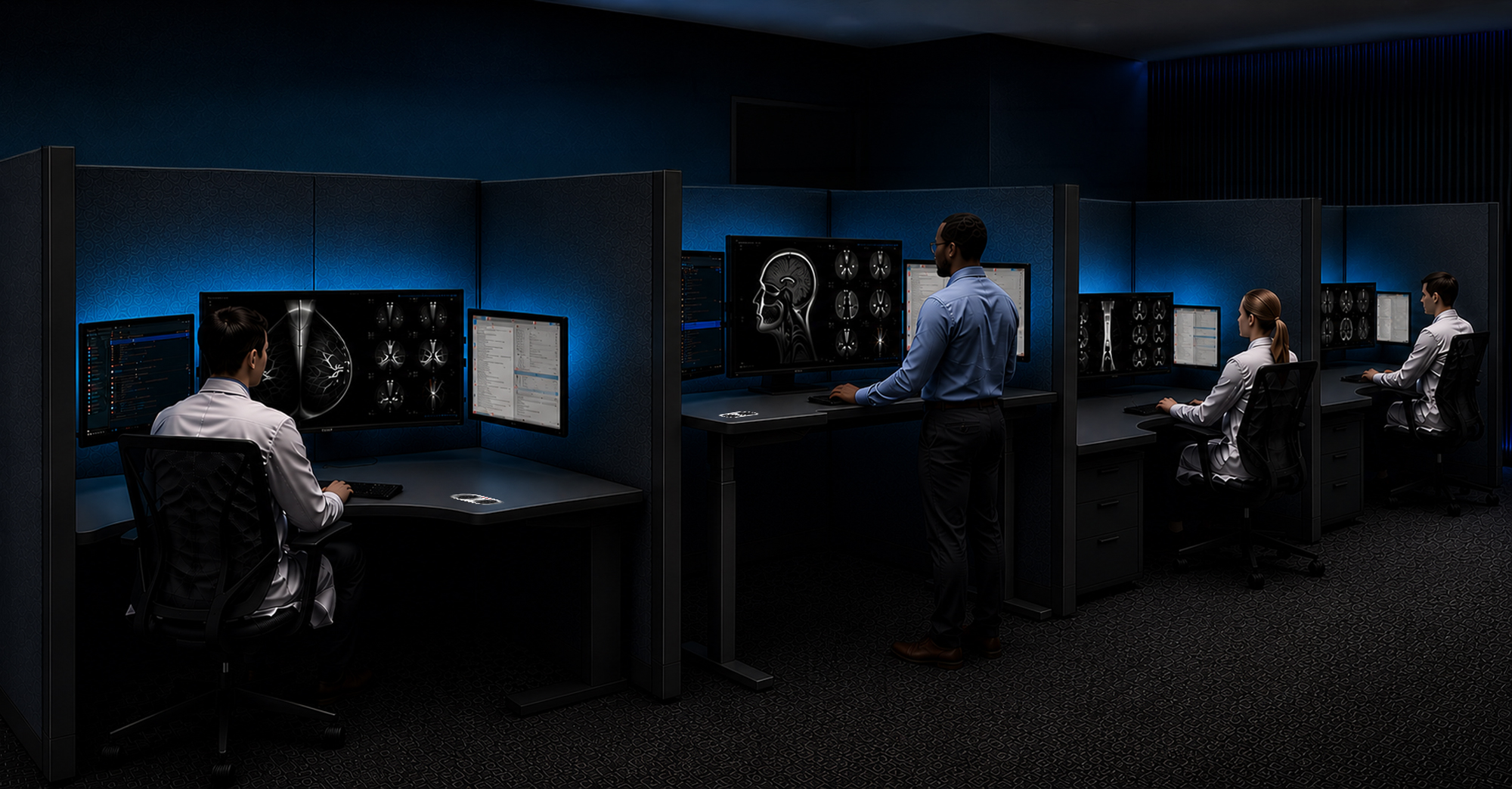
An example of an effective layout for a high-performance reading room.
Circulation as an invisible influence
Circulation within the reading room is often overlooked, yet it exerts a continuous and measurable influence on diagnostic performance. Unlike workstation design or display technology, its impact is rarely obvious in isolation, but over the course of a full shift, it becomes consequential. Within the radiologist’s immediate field of work, unnecessary movement, line-of-sight distraction, and unintended proximity introduce subtle interruptions that accumulate, fragment attention, and increase cognitive fatigue.
Well-designed circulation patterns:
Prevent direct intrusion into focused work zones, ensuring that radiologists are not subjected to frequent visual or physical interruptions during active interpretation
Minimize traffic near primary workstations, reducing peripheral motion that can unconsciously draw attention away from the diagnostic task
Maintain accessibility and workflow efficiency, allowing staff, clinicians, and support personnel to move through the space without compromising concentration or creating bottlenecks
Effective circulation design is therefore not simply about movement, but about protecting cognitive bandwidth and ensuring the environment supports, rather than competes with, the demands of diagnostic interpretation.
Visual stability and environmental control
Our ability to see and interpret images is highly sensitive to changes in the surrounding environment. In radiology, where diagnostic accuracy depends on the ability to detect subtle differences in contrast, density, and structure, even minor inconsistencies in the surrounding environment introduce competing visual stimuli that must be cognitively processed and filtered. This additional processing is not benign. It directly competes with the interpretive task.
Suboptimal environmental conditions such as glare on the display surface, uneven or excessive ambient lighting, reflections, and visual clutter degrade perceived image quality and increase visual effort. The eye is forced to continuously adapt to changing luminance levels and competing focal points, which over time contributes to visual fatigue, reduced contrast sensitivity, and diminished interpretive precision.
High-performance reading environments are therefore engineered to maintain visual stability through tightly controlled environmental parameters:
Controlled ambient lighting aligned with display requirements: Lighting levels are calibrated to complement diagnostic displays, typically maintaining low, indirect, and uniform illumination. This minimizes glare and reflections while preserving contrast sensitivity. Lighting color temperature is also selected to avoid perceptual distortion and maintain consistency with display output. In addition, integrating ambient lighting directly into the ergonomic workstation provides a more controlled and localized light source that moves with the user and the task. This reduces dependence on overhead lighting, minimizes environmental variability, and allows for precise adjustment at the point of interpretation. The result is improved visual comfort, reduced eye strain, and more consistent image perception throughout extended reading sessions.
Clean sight-lines and minimal visual noise: The visual field surrounding the workstation is intentionally simplified. Unnecessary objects, high-contrast patterns, and movement within the line of sight are reduced or eliminated. This prevents involuntary attentional shifts and allows the visual system to remain anchored on the diagnostic image.
Task lighting applied with precision: When localized lighting is required for documentation, keyboard use, or reference materials it is designed to be directional, adjustable, and isolated from the primary viewing area and not integrated into the ergonomic workstation. This ensures functionality without introducing spill light or reflections that could interfere with image interpretation.
Consistent material and spatial language: Finishes, colors, and surfaces within the reading room are selected to maintain low reflectivity and visual uniformity. Matte materials and neutral tones reduce glare and prevent visual distraction, creating an environment that supports sustained focus rather than competing for attention.
Sound mediation and acoustic control: While the reading room is primarily a visual environment, auditory conditions play a significant supporting role. Background noise, conversations, and intermittent sounds introduce cognitive interruptions that disrupt concentration. Acoustic treatments such as sound-absorbing materials and spatial separation help maintain a controlled auditory environment that supports uninterrupted diagnostic work.
Reducing environmental variability is fundamental to maintaining cognitive efficiency in the reading room. When the environment is controlled and consistent, radiologists are not forced to continually adapt to changing visual conditions, allowing them to focus fully on image interpretation. The radiologist is no longer required to adapt to the environment; the environment is engineered to support the radiologist. The result is cognitive efficiency. Visual attention remains stable, interpretive accuracy is preserved, and fatigue is reduced.
In a high-performance reading room, the environment becomes effectively invisible, receding into the background so that the full capacity of the radiologist’s focus can be directed toward the diagnostic task.
The interdependence of workstation, display, and the design environment
Ergonomic workstations, diagnostic displays, and reading room design are often treated as separate layers of a project; engineered, selected, and installed in sequence. In practice, they function as a single, interdependent system, with the ergonomic workstation serving as the foundational element. It establishes the positioning, alignment, and interaction point between the radiologist and the technology, effectively dictating how displays are viewed and how the surrounding environment must be configured. The overall performance of the reading room is not determined by any single component, but by how well the ergonomic workstation is designed and how effectively the diagnostic display and the surrounding environment support accurate, sustained image interpretation.
Defining the conditions for diagnostic performance
The workstation defines physical positioning: it establishes how the radiologist’s body aligns with the task, including posture, reach zones, and the spatial relationship to input devices and displays. Properly engineered, it enables neutral positioning, reduces physical strain, and ensures that interaction with imaging systems remains consistent and efficient throughout extended reading sessions.
The display defines visual conditions: it determines how image data is presented and perceived, including resolution, luminance, contrast, and grayscale accuracy. High-performance diagnostic displays ensure that subtle variations in anatomy and pathology are visible, supporting confident interpretation and reducing the risk of missed findings.
The room defines environmental context: it shapes how external factors such as lighting, acoustics, spatial layout, and movement either support or interfere with both physical alignment and visual perception. A well-designed environment minimizes distraction, controls variability, and preserves the conditions necessary for sustained concentration.

These elements function as a coordinated system rather than independent components. Optimal performance is achieved when ergonomic workstation design, display technology, and environmental conditions are deliberately aligned to support consistent, accurate, and uninterrupted diagnostic work.
At this level of integration, the environment no longer introduces competing variables. Instead, it becomes an extension of the radiologist’s workflow, supporting consistent positioning, stable visual conditions, and uninterrupted cognitive engagement.
This wholistic approach transforms the reading room from a collection of components into a unified performance environment that high-performing and invisible. It reduces variability, eliminates avoidable inefficiencies, and creates the conditions necessary for sustained diagnostic accuracy. Ultimately, the goal is not simply compatibility between elements, but alignment where physical design, visual technology, and spatial organization operate together with precision. In such an environment, performance is not dependent on an individual’s ability to adapt. The need for adaptation is removed and the conditions required for accurate, sustained interpretation are built directly into the reading room.
From immediate efficiency to long-term sustainability
The consequences of reading room design extend far beyond daily workflow. While the immediate impact is often measured in efficiency and throughput, the more significant effects emerge over time such as shaping the physical well-being, cognitive capacity, and long-term performance of the radiologist, as well as the operational stability of the institution.
Poorly engineered reading environments introduce continuous, compounding stressors. Over months and years, these conditions contribute to:
Chronic musculoskeletal strain driven by improper workstation or inadequate ergonomic design that offers limited adjustability, and which often results in neck, shoulder, and lower back pain that can reduce productivity and increase absenteeism
Progressive visual fatigue, caused by suboptimal display conditions, glare, and inconsistent lighting leading to decreased contrast sensitivity, slower interpretation, and increased visual effort
Accumulated cognitive exhaustion, as a result of constant environmental adaptation, interruptions, and inefficient workflows ultimately reducing focus, increasing error risk, and contributing to burnout
These outcomes are often regarded as unavoidable aspects of the profession. In reality, they are largely the consequence of environments that have not been deliberately engineered to support the demands of modern radiology. In contrast, thoughtfully designed reading environments create durable, compounding advantages for both the radiologist and the institution. The following is a list of just some of those advantages:
Sustained physical comfort across extended careers, enabled by ergonomic workstations that support neutral posture, dynamic movement, and proper alignment; reducing injury risk and supporting longevity in practice. This level of physical support minimizes cumulative strain over time, allowing radiologists to maintain productivity, focus, and clinical effectiveness throughout long shifts and across the span of their careers.
Reduced visual strain and improved perceptual clarity, achieved through optimized lighting conditions and high-performance diagnostic displays that support faster, more confident interpretation with less fatigue
Greater consistency in diagnostic accuracy, as stable physical, visual, and environmental conditions allow radiologists to maintain focus and reduce variability in performance across long shifts and high volumes
Enhanced cognitive endurance, by minimizing unnecessary interruptions and environmental distractions, preserving attentional capacity and supporting sustained high-level decision-making
Improved radiologist satisfaction and retention, as environments that actively support well-being and performance reduce burnout and create a more sustainable working experience
Operational stability and workforce continuity for the institution, reducing turnover, recruitment costs, and workflow disruption while maintaining a high standard of care
Over time, these advantages do not simply add up, they compound. Incremental reductions in fatigue, physical strain, and workflow inefficiency translate into sustained gains in diagnostic accuracy, cognitive endurance, and overall performance. In this context, performance is not defined by isolated moments of effort, but by consistency and the ability to deliver precise, reliable interpretation across long shifts and over the course of an entire career.
A thoughtfully engineered reading environment makes this level of consistency possible. It supports the radiologist not intermittently, but continuously, preserving focus, reducing variability, and maintaining the conditions required for high-level diagnostic work. For the institution, this translates into greater stability, stronger retention, and a more resilient clinical operation.
A high-performance reading room, therefore, is not merely an investment in efficiency. It is a strategic investment in the longevity of the radiologist, the reliability of diagnostic outcomes, and the sustained excellence of patient care.
A high-performance reading room is not defined by the presence of advanced technology or isolated ergonomic upgrades, but by how seamlessly every element works together to support sustained diagnostic focus. When properly designed, the workstation, the display, and the surrounding environment no longer compete for attention, they become transparent by removing friction from the interpretive process and allowing performance to emerge without resistance. In contrast, poorly aligned environments impose a constant, often invisible burden that radiologists are forced to compensate for with effort and endurance. The difference is not subtle. It is cumulative, measurable, and ultimately decisive. The reading room is no longer a passive backdrop to diagnostic work, it is an active determinant of how well, how long, and how consistently that work can be performed.